
Expanding Multilingual Interoperability in the COGNIT Device Runtime
Discover How COGNIT Enables a Unified Multi-Language Cloud-Edge Runtime
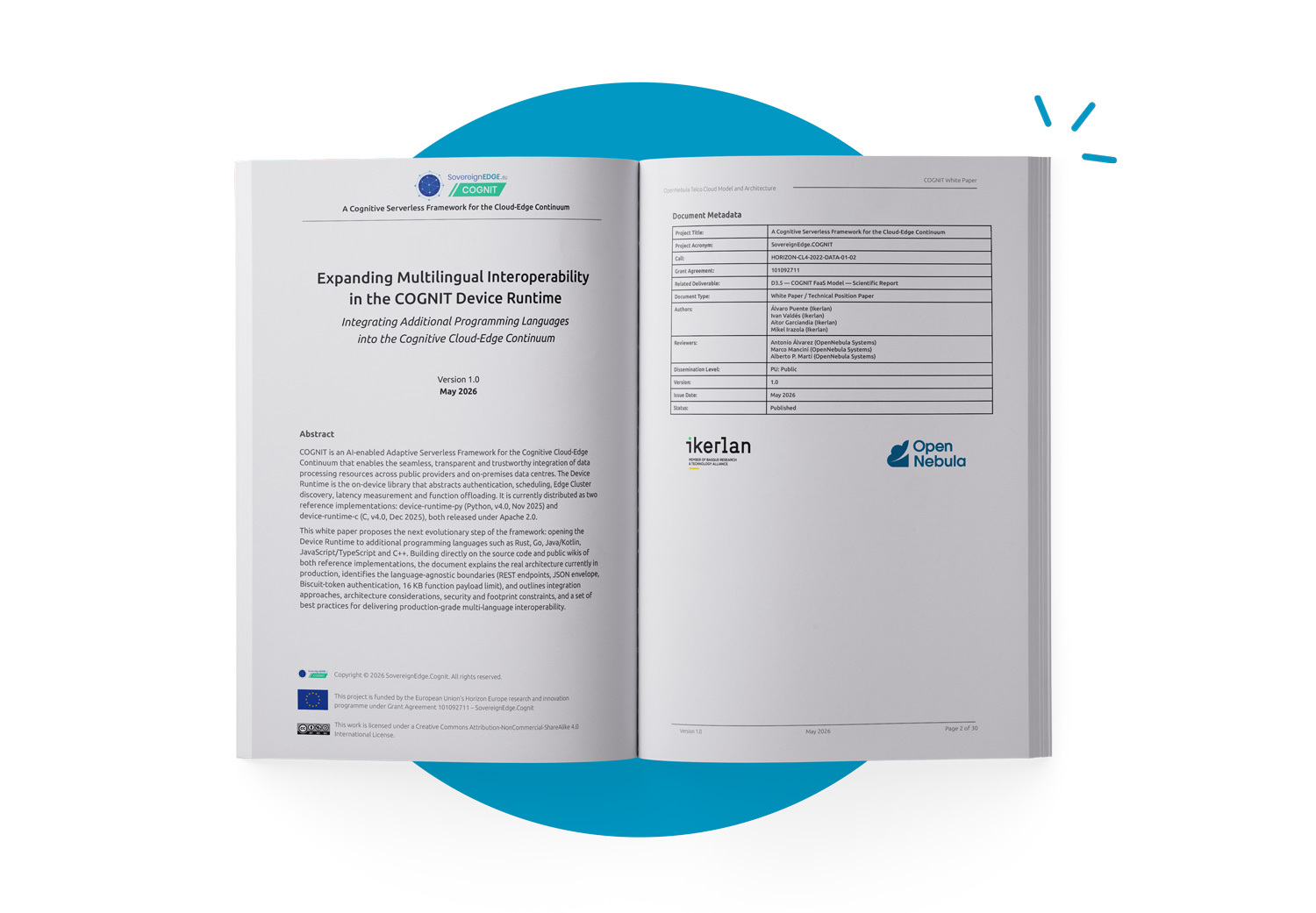
Modern cloud-edge applications need to run efficiently across highly diverse environments. But for most serverless frameworks, it remains a major challenge to support multiple programming languages in a consistent, secure, and scalable way.
This white paper describes how to extend the existing runtime architecture beyond Python and C, enabling support for additional languages such as Rust, Go, Java/Kotlin, JavaScript/TypeScript, and C++ without breaking interoperability or increasing system complexity.
What you’ll learn:
- A stable, language-agnostic protocol built on JSON-over-HTTPS and standardized REST endpoints
- How function serialization differs across languages while preserving a unified execution model
- Integration strategies, including native implementations, FFI-based bindings, and lightweight sidecar approaches
- Security, footprint, and portability considerations for edge-constrained environments
- Required evolution of the server-side runtime to support true multi-language execution
By following this approach, you can build once and deploy anywhere—choosing the best language for each workload while keeping behavior, security, and performance consistent across the entire cloud-edge continuum. This helps reduce integration overhead, improve portability, and unlock a more flexible and scalable serverless ecosystem.
Download Now
Acknowledgements
A project coordinated by OpenNebula Systems and funded by the European Union’s Horizon Europe research and innovation programme, under Grant Agreement 101092711 – SovereignEdge.Cognit [2023-2025].
