
Managing workloads across distributed environments is often complex, requiring manual coordination, multiple interfaces, and deep familiarity with each platform. But what if your organization could operate several geographically dispersed infrastructure zones through a single, unified interface—while keeping full control of the cloud platform itself?
This demonstration highlights exactly that. Instead of acting as a cloud broker, OpenNebula uses bare-metal servers from different providers to deploy independent OpenNebula cloud instances, each running entirely under our platform’s control. These instances—hosted on raw infrastructure in Madrid, Berlin, and other locations—are then federated into a single logical cloud managed from one OpenNebula Frontend.
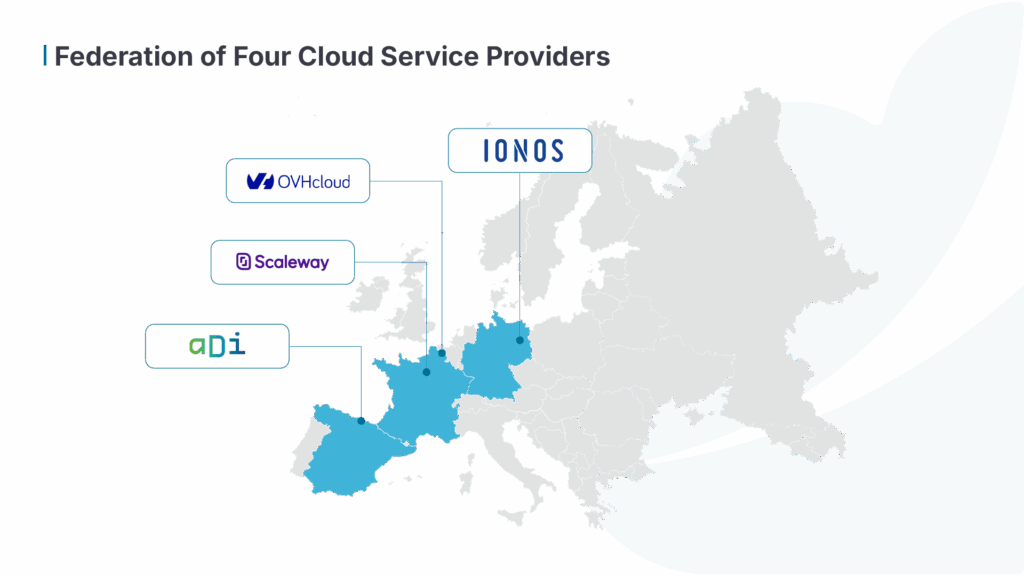
In this demo, four OpenNebula-based clouds deployed on bare-metal from OVHcloud, IONOS, Scaleway, and ADI Data Center Euskadi operate together as a unified environment. The result is a consistent, centrally managed multi-site architecture where OpenNebula governs every layer of the cloud platform—not a broker of external clouds. This enables seamless orchestration, operational uniformity, and clear visibility across all federated sites.
Key Capabilities
- Single pane of glass: A unified OpenNebula interface is used to monitor, schedule, and manage workloads across four OpenNebula-based cloud instances deployed on bare-metal servers in different locations.
- Federated cloud architecture: The OVHcloud deployment operates as the Master Zone, while Scaleway, IONOS, and ADI Data Center Euskadi function as secondary zones. Each site runs its own OpenNebula cluster and hosts, but all are centrally governed through federation—not through external provider APIs.
- Flexible networking options: Scaleway and IONOS zones communicate over public networking, while ADI Data Center Euskadi connects through a secure private VPN, ensuring consistent control-plane communication across sites.
- Transparent infrastructure visibility: From the Master Zone, administrators can inspect each site’s hypervisor hosts, available resources, and real-time workload status, maintaining full visibility across all federated environments.
- Cross-zone orchestration: Virtual machines are instantiated from the OVHcloud control plane but deployed directly into each federated OpenNebula cloud, enabling distributed workload placement with a unified operational model.
Whether the goal is to support distributed AI workloads, enhance resilience, or build geo-redundant architectures, this federation model delivers operational consistency and simplicity across multiple OpenNebula-controlled cloud instances.
Watch the Full Demo: Federating Four Clouds Under One Control Plane
Our screencast walks through the full lifecycle of multi-cloud federation—from inspecting the federated architecture to provisioning VMs across all environments and verifying live access.
In the demo, you’ll see how to:
- View each OpenNebula zone (OVHcloud, Scaleway, IONOS, and ADI Data Center Euskadi) and inspect their available hypervisor hosts
- Use a single web interface on OVHcloud to deploy Virtual Machines into each remote zone
- Confirm each VM is scheduled and successfully instantiated
- Verify the federation architecture through real-time infrastructure and workload visibility
- Access a deployed VM’s root console through VNC to validate connectivity and execution.

More screencasts are available here.
By federating OpenNebula clouds, organizations gain the ability to operate highly distributed environments with unified governance, consistent workflows, and full operational transparency. Whether you’re building resilient architectures, testing multi-site strategies, or supporting regional deployments, OpenNebula’s federation model offers a practical and scalable approach for orchestrating multiple OpenNebula-based clouds as a single cohesive platform.

Funded by the Spanish Ministry for Digital Transformation and Civil Service through the ONEnextgen Project (UNICO IPCEI-2023-003), and co-funded by the European Union’s NextGenerationEU through the RRF.



0 Comments