
ISC High Performance 2026 once again brought together the global HPC community to explore the technologies driving the next generation of AI and high-performance computing. Throughout the event, the OpenNebula Systems team welcomed customers, partners, and industry experts at its dedicated booth to discuss one of the biggest challenges: operating increasingly complex AI and HPC infrastructures efficiently.
As AI Factory initiatives continue to gain momentum across Europe, organizations are looking beyond hardware performance to address operational complexity, resource utilization, and digital sovereignty. These conversations reinforced the growing need for a unified infrastructure management platform capable of dealing with diverse compute environments in an easy way.
Sharing Our Vision at the Exhibitor Pitch
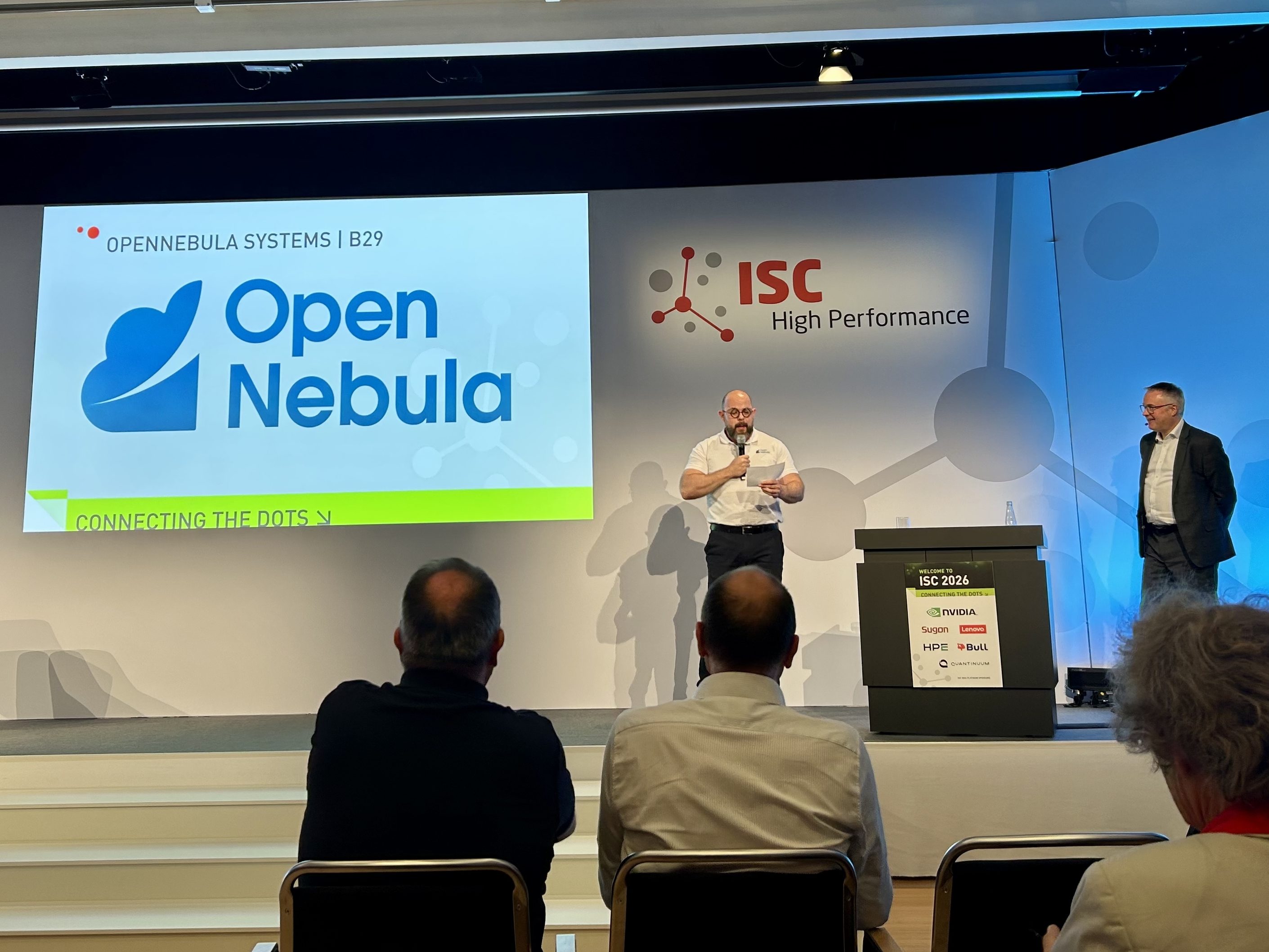
We took the stage during the ISC Exhibitor Pitch session to present how organizations can simplify AI Factory operations by bringing virtualization, Kubernetes, Slurm, and AI services together on a single vendor-neutral platform.
Rather than managing cloud, HPC, and AI environments independently, OpenNebula provides an infrastructure-first control plane that unifies these technologies across distributed infrastructures and multiple resource partitions. This approach helps operators streamline infrastructure management, improve GPU utilization, accelerate AI deployment, and maximize hardware ROI.
The session also highlighted OpenNebula’s unique position as the only European cloud platform validated by NVIDIA as an ISV for NVIDIA Cloud Partner (NCP) environments, while also supporting AMD GPU platforms and emerging European accelerator technologies, enabling organizations to build sovereign AI infrastructure without vendor lock-in.
Showcasing AI Factory Infrastructure in Action
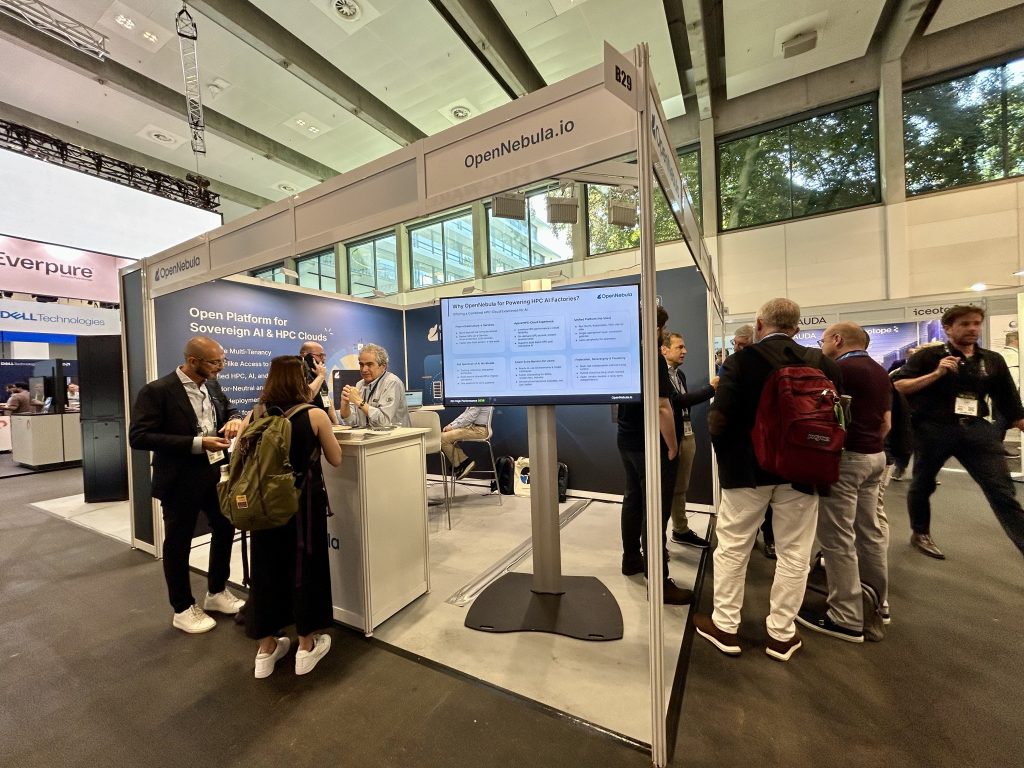
Throughout the week, visitors stopped by our booth for on-demand demonstrations exploring how OpenNebula helps organizations build and operate AI Factories on sovereign, vendor-neutral infrastructure.
Discussions covered every layer of the AI stack, from GPU Infrastructure-as-a-Service and AI Factory architectures to Kubernetes automation, elastic HPC environments, and LLM inference. Rather than focusing on individual technologies, attendees were interested in how these capabilities work together within a unified platform to simplify operations across cloud, HPC, and AI workloads.
Among the solutions demonstrated were:
- AI Factory Architecture, showcasing how OpenNebula unifies virtualization, Kubernetes, AI services, and HPC into a single operational platform.
- GPU Infrastructure-as-a-Service, enabling secure multi-tenant access to accelerated computing resources while maximizing GPU utilization.
- OneKS, which automates the deployment and lifecycle management of Kubernetes clusters for AI-native applications.
- OneLLM, demonstrating simplified deployment and operation of LLM inference services on shared GPU infrastructure.
- OneSlurm, extending OpenNebula with elastic Slurm clusters that can be provisioned on demand for AI training and traditional HPC workloads.
These demonstrations sparked valuable conversations with organizations looking to reduce infrastructure complexity while maintaining the flexibility to support diverse AI and HPC use cases across distributed environments.
Discover how OneSlurm simplifies HPC batch scheduling for AI training and cloud-native HPC environments here.
Thank You for Visiting Us
ISC High Performance continues to be one of the most important meeting points for the European HPC and AI ecosystem, providing an excellent opportunity to exchange ideas with customers, partners, researchers, and infrastructure operators.
A big thank you to everyone who visited the OpenNebula booth, attended our Exhibitor Pitch, or joined one of our live demonstrations throughout the week. We appreciate all the conversations and look forward to continuing them as organizations accelerate their AI Factory and HPC initiatives.
Explore how OpenNebula helps organizations build efficient, sovereign AI Factories with an infrastructure-first approach in our latest blog.

0 Comments