
Digital Twins are becoming a core capability for modern industrial and logistics platforms, enabling real-time visualization, simulation, and optimization of complex physical environments. To operate at scale, these systems require ultra-low latency connectivity, deterministic performance, and flexible placement of compute and network functions across data centers and edge locations. This is especially critical in large-scale operational environments such as ports, where thousands of sensors, cameras, and control systems must remain continuously synchronized with their virtual counterparts.
From 5G User Plane to Deterministic Industrial Connectivity
Beyond-5G networks introduce the performance characteristics required by real-time Digital Twins: high throughput, sub-10 ms latency, and predictable jitter. A key component is the 5G User Plane Function (UPF), which handles data traffic between devices and applications. Its placement and performance directly impact the responsiveness of time-sensitive workloads such as 3D visualization, video analytics, and closed-loop industrial control.
By leveraging Control and User Plane Separation (CUPS) and distributing UPFs closer to the edge, enterprises can significantly reduce end-to-end latency and improve determinism. Benchmarking different open-source UPF implementations under realistic traffic conditions shows that VPP-accelerated and high-performance data planes can sustain the throughput and latency requirements of large-scale Digital Twin platforms, even when thousands of concurrent data streams are active.
OpenNebula as a Unified Cloud-Edge Platform for Telco and Industry
OpenNebula plays a central role in enabling these capabilities at enterprise scale, particularly for ports and industrial facilities. Acting as a unified IaaS and Kubernetes management platform, OpenNebula allows:
- Hybrid orchestration of virtual machines and containerized workloads
- Automated deployment of 5G core functions and UPFs across central data centers and edge sites
- Performance-aware scheduling and multi-tenancy for shared telecom and industrial infrastructures
- Integration with emerging telco cloud stacks and open European initiatives, such as the Sylva Project.
This makes OpenNebula particularly well suited for mission-critical port environments, where performance isolation, operational continuity, and long-term scalability are essential.
This unified control plane allows enterprises and service providers to place network functions, AI pipelines, and Digital Twin components exactly where they deliver the most value: at the edge for ultra-low latency interaction, or centrally for large-scale analytics, simulation, and model training.
Benchmarking for Real-Time Digital Twin Workloads
Performance evaluations of multiple UPF implementations demonstrate how software-defined data planes can be tuned for different industrial requirements:
- High-throughput UPFs are well suited for video-intensive services such as multi-camera inspection and 3D scene reconstruction
- VPP-based UPFs deliver superior latency, jitter, and packet-loss characteristics, making them ideal for real-time synchronization and control loops
- Distributed placement and load balancing across edge and core sites improve both scalability and resilience.
In port environments, this translates into smoother real-time visualization, more accurate simulation feedback, and reliable operation of AI-driven analytics and control applications.
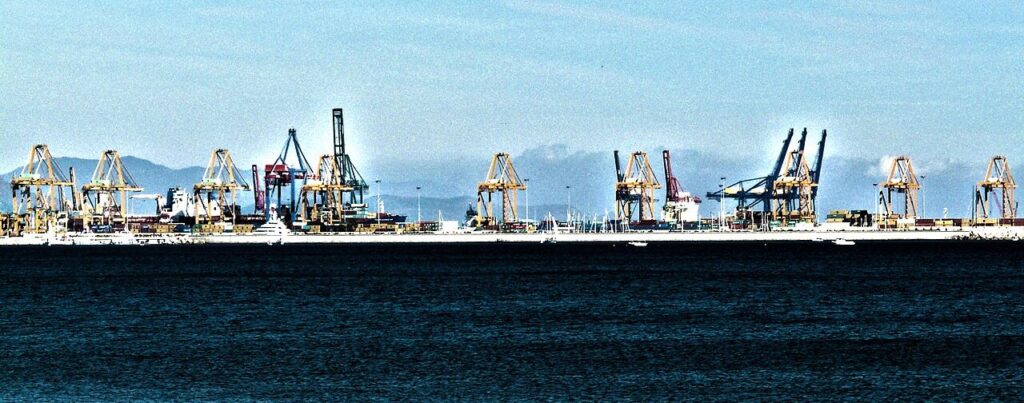
Digital Twins in Smart Port Environments
In a smart port scenario, like in this use case with the Port of Valencia, these capabilities enable the creation of a live 3D replica of assets and operations, continuously fed by IoT sensors and high-resolution video streams. Such a Digital Twin supports:
- Real-time situational awareness and safety monitoring
- Simulation of logistics flows and congestion scenarios
- Energy-efficiency optimization and environmental monitoring
- Predictive maintenance and AI-driven decision support.
The combination of deterministic 5G connectivity, edge computing, and OpenNebula’s cloud-edge orchestration provides the operational foundation to deploy these platforms at scale, with guaranteed performance, isolation, and flexibility.
From Advanced Testbeds to Production-Ready Platforms
Close collaboration between technology providers and research institutions has helped validate these architectures in realistic operational environments, feeding back into improvements in orchestration workflows, Kubernetes and VNF integration, and hybrid cloud-edge operations. This accelerates the transition from experimental setups to production-ready platforms adopted by telecom operators, port authorities, and industrial enterprises.
The work described here has been developed and validated in the context of the ADV5G-TWINS-MEC project, funded by the Universitat Politècnica de València and European research programs, where OpenNebula is used as the cloud-edge management platform to support production-ready Digital Twin deployments in port and industrial environments.
🇪🇺 These innovation activities have been carried out as part of the Avanzando-5G-Digital-Twins Project (TSI-063000-2021-112), an initiative funded by the UNICO I+D 5G Programme of the Recovery, Transformation and Resilience Plan through the Spanish Ministry for Digital Transformation and the Civil Service and the NextGenerationEU instrument.



0 Comments