
Welcome to our newsletter! Dive into this edition to catch up on our latest updates, event highlights, future plans, and more.
Product
OpenNebula 7.2 Beta is now available and represents a significant step forward in making the platform easier to operate, more scalable, and better prepared for AI-driven infrastructures.
- With Storage Live Migration for LVM and file-based datastores, virtual machines can now move across hosts without interruption, making maintenance, hardware refreshes, and workload rebalancing far easier and less disruptive.
- The introduction of OneForm streamlines the deployment of OpenNebula clusters across on-premises and cloud environments. It reduces manual setup, enforces consistency, and accelerates the rollout of new regions or sites, which is especially valuable in multi-datacenter or hybrid scenarios.
- A new gRPC API improves integration with external systems and automation frameworks, enabling more efficient DevOps workflows and tighter integration with surrounding infrastructure tools.
- On the AI side, expanded GPU support, including built-in NVIDIA Fabric Manager integration, compatibility with GB200 systems, and integration with Spectrum-X Ethernet networking, strengthens OpenNebula’s ability to manage modern accelerated infrastructure. This makes it easier to operate AI Factories and high-performance environments with less manual configuration.
- Security and enterprise readiness are also reinforced. Confidential Computing and vTPM for KVM provide stronger protection for sensitive workloads, while enforced two-factor authentication in Sunstone improves access control in production deployments.
- Improved Enhanced vCPU Compatibility (EVC) simplifies workload mobility across heterogeneous hardware, reducing friction during migrations and upgrades.
- Support for the latest operating systems—AlmaLinux 10, RHEL 10, SUSE 16, and Debian 13—ensures alignment with current enterprise standards and long-term platform stability.
- Additional enhancements improve efficiency and observability. These include NetApp incremental backups to reduce storage overhead, optimized LVM drivers, multi-tier caching for local datastores, and integrated VM logs directly within Sunstone for faster troubleshooting.
Overall, OpenNebula 7.2 Beta focuses on practical improvements that simplify day-to-day operations and increase flexibility in production environments.
Moreover, we published an in-depth blog outlining how OpenNebula delivers compelling value for Neocloud environments by combining flexible hybrid cloud control with high-performance virtualization. The post highlights how OpenNebula’s modular architecture supports multi-tenant governance, efficient resource usage, and robust security, making it an attractive choice for organizations seeking an open, adaptable alternative to proprietary cloud stacks. Don’t miss the full blog.
We also introduced a new OpenNebula Deployment ISO, designed to simplify installation across bare-metal environments. The ISO enables streamlined, reproducible setups of the OpenNebula frontend and associated services, helping reduce manual configuration overhead and ensure consistent deployments from the start. Together, these updates emphasize OpenNebula’s focus on accessibility, reliability, and operational readiness for clouds of all sizes. Check out the post.
Enterprise Alliances
We’re pleased to announce certified support for NVIDIA Spectrum-X Ethernet networking within OpenNebula’s ecosystem of key integrations. This support has been validated using the NVIDIA Air environment. Spectrum-X delivers a next-generation Ethernet fabric purpose-built for AI and high-performance cloud workloads, and its certification through NVIDIA Air ensures accurate, production-grade validation of performance, latency, and interoperability. This integration further strengthens OpenNebula’s ability to support demanding, latency-sensitive AI environments while expanding hardware compatibility for customers building scalable hybrid, edge, and AI-ready infrastructures. Read more about the integration here.
Innovation
Our Innovation team has developed a new white paper outlining a practical framework for Telco AI Factories, showing how telecom operators can deploy sovereign, AI-driven infrastructure at the edge and across distributed environments. The accompanying blog highlights the key elements of the framework, including architectural principles, governance and interoperability considerations, and strategies for efficient, scalable deployment of AI workloads. It’s a concise overview of the white paper’s core ideas and insights, offering a clear picture of how AI Factories can be implemented in telco environments. Download the white paper here.
We’ve also published a new innovation update exploring the role of Open Source MANO (OSM) in orchestrating virtualized network functions (VNFs) and cloud-native network functions (CNFs) across modern infrastructure. The post highlights how OSM integrates with OpenNebula to deliver automated lifecycle management for network services—bridging traditional telco environments with next-generation cloud and edge deployments. By leveraging open, standards-driven orchestration, organizations can achieve more flexible, scalable, and interoperable infrastructure for both legacy and cloud-native workloads. Review the full blog.
Experiences
OpenNebula Reviews on Gartner
Discover what users are saying about OpenNebula on Gartner Peer Insights! The latest reviews highlight OpenNebula’s reliability and control over infrastructure and resources, as well as flexibility with existing systems and virtualization setups; flexible KVM, VMware and public cloud integrations for all types of environments; and simplification of on-premise and cloud infrastructure management tasks. Click here to read the full details.
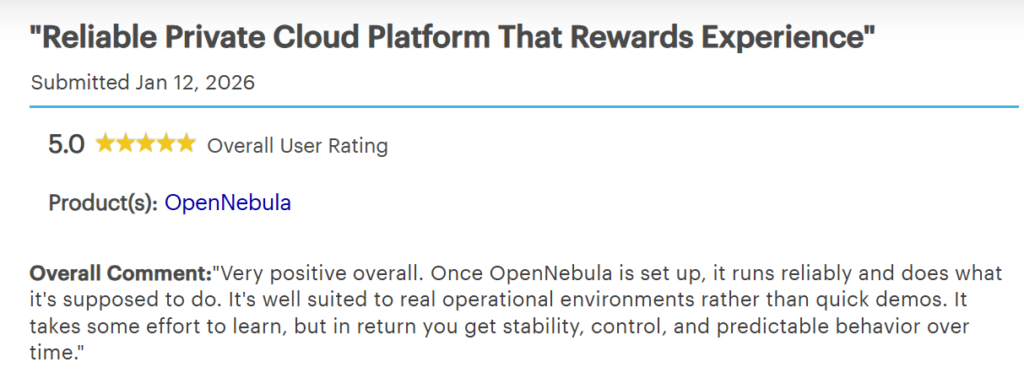
Are you using OpenNebula? We’d love your feedback! Submit your review here, and as a thank-you, receive a gift card once it’s published.
Media Publications
OpenNebula was recently featured in The Register, where our approach to sovereign, open infrastructure and its role in Europe’s cloud landscape was highlighted in depth. The interview discusses how OpenNebula enables organizations to build and operate independent cloud and AI platforms, reinforcing the importance of transparency, control, and regional data governance. It’s a strong validation of our strategic direction and continued relevance in the context of global infrastructure trends. Read the article here.
OpenNebula was also cited in TechRadar Pro in an article discussing how organizations can turn a VMware exit into a strategic advantage by adopting alternative cloud platforms. The piece highlights trends in infrastructure modernization and the shift toward more open, flexible solutions that reduce dependency on legacy hypervisors while enhancing control and governance. OpenNebula’s role in this landscape underscores its value for enterprises embracing hybrid, multi-cloud, and sovereign cloud strategies. View the piece here.
To round up the month, Euractiv published an opinion piece discussing the strategic importance of sovereign AI Factories and Europe’s path to building independent, resilient infrastructure. The article highlights the growing need for interoperable, locally controlled cloud environments, and features insights from OpenNebula on how open source and modular architectures can help organizations deploy AI-ready, sovereign infrastructures. Read the full piece here.
Webinars, TechDays and Academy
Webinars
We kicked off the month with the Office Hours session on “OneFlow Services in OpenNebula”, reviewing how to overcome the challenges of deploying and managing multi-tier applications, as well as coordinating dependencies between VMs, configuring networking, and scaling applications.
Later on, we presented the webinar “How to Evaluate OpenNebula: FromSelf-Testing to PoC”, where we navigated through the process of evaluating a new cloud platform, from self-testing in your own environment to running a Proof of Concept (PoC) with our team.
Here are the upcoming webinars, with more to come soon. Details to be shared shortly!
- Orchestrating AI Factories with OpenNebula and NVIDIA Spectrum-X Ethernet Networking—March 11 at 5 PM CET/11 AM EST. Learn more and register here.
- Office Hours: Kubernetes in OpenNebula—March 18 at 5 PM CET/11 AM EST. Learn more and register here.
OpenNebula Academy
A quick reminder that OpenNebula Academy now has its own dedicated training hub! Explore our range of certified training sessions for all skill levels designed to give you hands-on experience and help you deepen your OpenNebula expertise. You can now browse upcoming sessions and inquire directly with our team through the new Academy page here!
Additionally, we’ve released a new playlist of microlearnings. Don’t forget to check them out here.
Screencasts
We’ve launched a brand-new Screencasts hub to make it even easier to explore OpenNebula features through new, short, practical walkthroughs—designed to get you from zero to “it works” without the fluff. The new page brings together visual guides focused on real operational scenarios, helping teams validate integrations and workflows faster. Check it out here.
A special new screencast we’d like to draw your attention to is now live. “Integrate OpenNebula and Veeam Backup & Replication” walks through how to connect OpenNebula with Veeam using the oVirt API module and demonstrates backup and restore operations end to end. It’s a hands-on look at how to strengthen data protection in OpenNebula environments. Dive deeper here.
Events
Software & Standards for Smart Networks & Services 2026 (ETSI SNS4SNS), Sophia Antipolis, February 2–5
Earlier this month, we participated in ETSI SNS4SNS 2026, a multi-day event bringing together open source communities, standards bodies, researchers, and industry leaders focused on the future of smart networks and services. The conference featured in-depth discussions, tutorials, and live demonstrations on open software ecosystems, interoperability, and next-generation connectivity—key themes closely aligned with OpenNebula’s work across cloud, edge, and telco environments.
OVHcloud Summit 2026, Madrid, February 19
We also took part in OVHcloud Summit 2026 in Madrid, where we shared OpenNebula’s perspective on digital sovereignty and the strategic role of open, European cloud infrastructure. During the session we highlighted the importance of collaboration within the ecosystem and showcased how OpenNebula and OVHcloud are working together to enable sovereign, scalable cloud environments across Europe.
What’s Coming in March (and April!)
We have several upcoming offline events.
Mobile World Congress (MWC) 2026, Barcelona, March 2–5
We’re present at MWC 2026, the world’s leading event for connectivity, telecom, and digital innovation. It brings together operators, vendors, policymakers, and technology leaders to explore the future of 5G, edge, cloud, and AI. It’s a key venue to discuss how open, sovereign cloud and AI infrastructure can support next-generation networks and digital services at scale. Stop by our dedicated booth to meet the team. Check out the full details.
EuroHPC Summit 2026, Paphos, March 10–12
We’ll be taking part in the EuroHPC Summit 2026, where we’re especially looking forward to engaging with the EuroHPC AI Factory community—sharing insights, exploring new partnership opportunities, and showcasing how OpenNebula enables the design and operation of AI Factories at scale. If you’ll be in attendance, let’s talk about how we support GPUaaS, K8saaS, and LLMaaS workflows with a flexible, scalable, and efficient infrastructure platform. While we integrate with SLURM, our focus is on enabling end-to-end AI Factory workloads, spanning training, fine-tuning, and inference across heterogeneous environments. For more information, click here.
NVIDIA GTC 2026, San Jose, USA, March 16-19
We’ll also be attending NVIDIA GTC 2026, a flagship conference dedicated to AI, accelerated computing, and high-performance infrastructure. In our dedicated booth, we’ll be engaging with attendees to showcase OpenNebula. GTC brings together developers, researchers, and enterprises to explore advances in GPU technologies, AI platforms, and real-world use cases—key topics for organizations building and operating AI Factories and GPU-powered cloud environments. More on the event here.
CloudFest 2026, Europa-Park, March 23–26
Catch us at CloudFest 2026, one of the largest global gatherings for cloud infrastructure, hosting, and service providers. The event focuses on scalable cloud platforms, open ecosystems, and emerging technologies shaping the internet economy. You’ll find us at booth R37—stop by to meet the team and discuss open source cloud strategies, sovereign infrastructure, and practical VMware alternatives for modern workloads.
Flower AI Summit, London, April 15-16
We’ll also be participating in the Flower AI Summit 2026, a premier gathering of AI innovators, researchers, and practitioners focused on advancing federated and privacy-preserving AI technologies. The event brings together leaders from industry and academia to explore breakthroughs in collaborative learning, secure AI workflows, and decentralized intelligence. We look forward to engaging with the community and sharing insights on scalable, open approaches to AI infrastructure.
OneNext 2026, Brussels, April 28–30
In April, our focus turns to OneNext 2026 re:Virtualize, OpenNebula’s flagship and the most important event on our calendar this year. OneNext brings together leading voices from across cloud, AI, edge, and open infrastructure to explore how sovereign, production-ready platforms are being built in Europe and beyond. A first set of speakers is already confirmed, with new names being added every week. You can follow the latest updates and explore the growing lineup on the dedicated event landing page—and this is just the beginning. More announcements, sessions, and details are coming very soon. Register your spot now here. Early bird tickets are ending soon!
Knowledge Base Articles
Exclusive Resources for OpenNebula Subscribers
This month’s featured article focuses on a practical but critical operational task: automating backups of your OpenNebula configuration.
How to Automate Backups for OpenNebula Configuration
Recovering from an unexpected failure is much easier when the right components are safely backed up. This step-by-step guide walks administrators through building a simple, reliable backup workflow for OpenNebula using a scheduled cron job. It covers how to safeguard the most important elements of a deployment, including the OpenNebula database, core configuration files, and authentication data, and how to securely transfer backups to an external server.
The article shows you how to:
- Identify and back up the OpenNebula database for fast recovery
- Preserve critical configuration and authentication files
- Automate the process with a reusable script and weekly cron job
- Reduce recovery time and operational risk with a lightweight, repeatable setup.
This guide is ideal for operators looking to strengthen resilience and ensure their OpenNebula environments are prepared for the unexpected.
Ready to join our customer community and unlock exclusive content?
Subscribe to Our Newsletter
Want to receive these updates in your inbox every month? Register using the form below.



0 Comments