
Welcome to our newsletter! Dive into this edition to catch up on our latest updates, event highlights, future plans, and more.
Leadership Insights
Looking back at 2025, it’s clear it was a defining year for OpenNebula. From major platform advancements to new partnerships and growing momentum around sovereign cloud and AI infrastructure, the year brought meaningful progress across the ecosystem. Our latest year-in-review captures the key milestones and sets the direction for what’s ahead in 2026. It’s a concise snapshot of where we’ve been—and where we’re going next. Read the 2025 Year in Review.
Product
We’re giving the finishing touches to OpenNebula 7.2. Expect huge new additions: OneForm to create OpenNebula on-prem or remote clusters on public cloud provider hardware, Storage Live Migration (now we know you’re waiting for this one!), PureStorage integration, NVIDIA Spectrum-X validation, NVIDIA GB200/300 validation … stay tuned!
Moreover, we’ve launched a new AI Factories blog series designed to help organizations move from experimentation to production with AI, focusing on real infrastructure, operational clarity, and long-term control.
The first two posts set the foundation. “AI Factories with OneDeploy” explores how to automate the deployment of validated AI Factory environments using OpenNebula’s OneDeploy, making it easier to roll out consistent setups across on-premises, edge, and hybrid clouds. You can read all about it here.
“AI Factories: LLM Inference with vLLM” complements this with a hands-on guide to running and benchmarking large language models using the vLLM appliance from the OpenNebula Marketplace, delivering clear and reproducible performance insights for GPU-accelerated clouds. Together, these articles outline a practical, infrastructure-first blueprint for building scalable and sovereign AI Factories. View the guide here.
Keep an eye out, there’s more to come soon.
Enterprise Alliances
We’re pleased to announce an expanded alliance with Red Hat through support for Red Hat Enterprise Linux within OpenNebula’s ecosystem. This integration offers customers a fully supported Red Hat Enterprise Linux experience when deploying and managing workloads on OpenNebula, bringing the stability, security, and enterprise-grade capabilities of RHEL together with OpenNebula’s flexible hybrid cloud platform. Read the full release blog here.
Meanwhile, we have announced a collaboration with OVHcloud that makes OpenNebula available on OVHcloud’s certified European infrastructure, enabling organizations to deploy fully sovereign cloud environments. Built entirely under EU jurisdiction and aligned with the European Commission’s Cloud Sovereignty Framework, the joint solution provides a trusted, scalable foundation for enterprises, research organizations, and regulated sectors building private, hybrid, and distributed cloud infrastructures across Europe. View all the details of the partnership.
Additionally, we’ve expanded our partner ecosystem in the CEE region with Comtrade System Integration. As a trusted system integrator for enterprise and public sector customers, Comtrade is using OpenNebula to enable flexible private and hybrid cloud environments with full control over infrastructure and data—supporting unified, vendor-neutral cloud strategies without lock-in. Catch up with their blog here.
Innovation
OpenNebula has introduced the Sylva First Validation Platform, a comprehensive framework for validating carrier-grade infrastructure built on the Sylva open reference architecture. This reinforces OpenNebula’s commitment to enabling sovereign, scalable cloud environments aligned with real-world telco and edge use cases. View the complete blog here.
Real-time Digital Twins are moving from experimentation to operational reality in complex environments such as ports. In our latest blog post, we explore how deterministic 5G connectivity combined with cloud-edge orchestration enables low-latency, scalable Digital Twin platforms for smart port operations. Don’t miss the full blog.
Experiences
OpenNebula Reviews on Gartner
Discover what users are saying about OpenNebula on Gartner Peer Insights!
Are you using OpenNebula? We’d love your feedback! Submit your review here, and as a thank-you, receive a gift card once it’s published.
Webinars, TechDays and Academy
Webinars
We kicked off the year with the “Office Hours on Virtual Machine High Availability in OpenNebula”, looking into the Virtual Machine HA feature in OpenNebula and discussing how the platform provides a robust safety net for your workloads, ensuring platform stability and data integrity regardless of infrastructure challenges.
We wrapped up by presenting the webinar “OneSwap Updates: VMware-to-OpenNebula Migration Tool”, where we took a deep dive into OneSwap—an open source tool that we built to help organizations seamlessly transition from VMware to OpenNebula, allowing them to simplify VM migrations, making it easier to move workloads with minimal downtime and no disruption.
Here are the upcoming webinars, with more to come soon. Details to be shared shortly!
- Introduction to Sovereign AI Factories: from Automated Deployment to LLM Inference—February 4 at 5 PM CET/11 AM EST. Learn more and register here.
- Office Hours: OneFlow Services in OpenNebula—February 11 at 5 PM CET/11 AM EST. Learn more and register here.
OpenNebula Academy
A quick reminder that OpenNebula Academy now has its own dedicated training hub! Explore our range of certified training sessions for all skill levels designed to give you hands-on experience and help you deepen your OpenNebula expertise. You can now browse upcoming sessions and inquire directly with our team through the new Academy page here!
Events
EU Open Source Policy Summit, Brussels, January 30
OpenNebula Systems took part in the EU Open Source Policy Summit 2026, where public and private sector leaders came together to discuss how open source technologies can strengthen Europe’s digital sovereignty. The event provided a valuable forum to exchange perspectives on policy, innovation, and collaboration, and to reaffirm the critical role of open, transparent infrastructures in building resilient and sovereign digital ecosystems across Europe.
FOSDEM 2026, Brussels, January 31–February 1
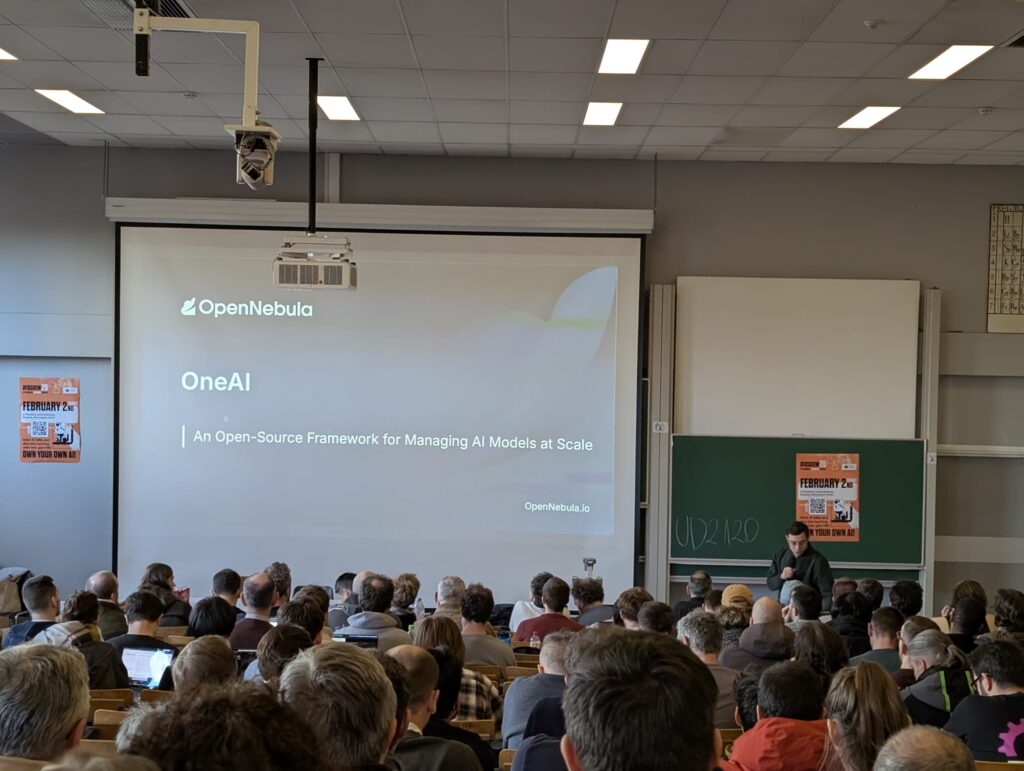
We also participated in FOSDEM 2026, one of Europe’s flagship open source events, reinforcing our position as a European open source platform for Sovereign AI Factories. Throughout the conference, we shared how OpenNebula is consolidating a full sovereign AI stack as part of the €3B IPCEI-CIS initiative, and highlighted opportunities for collaboration and integration within the Fact8ra ecosystem. FOSDEM was a great opportunity to exchange ideas with the community and explore new synergies. The full recap blog post will be published soon.
What’s Coming in February (and March!)
We have several upcoming offline events.
Software & Standards for Smart Networks & Services 2026, Sophia Antipolis, February 2–5
We’re participating in ETSI SNS4SNS 2026, a multi-day event bringing together open source communities, standards bodies, researchers, and industry leaders to shape the future of smart networks and services. The conference will feature tutorials, live demonstrations, and discussions on building open software ecosystems for future connectivity, interoperability, and innovation across next-generation networks.
Mobile World Congress (MWC) 2026, Barcelona, March 2–5
OpenNebula Systems will be present at MWC 2026, the world’s leading event for connectivity, telecom, and digital innovation. The event brings together operators, vendors, policymakers, and technology leaders to explore the future of 5G, edge, cloud, and AI. It’s a key venue to discuss how open, sovereign cloud and AI infrastructure can support next-generation networks and digital services at scale. We will have a dedicated booth. Check back soon for the blog with all the details.
EuroHPC Summit 2026, Paphos, March 10–12
We’ll be taking part in the EuroHPC Summit 2026 where we’re especially looking forward to engaging with the EuroHPC AI Factory community—sharing insights, exploring new partnership opportunities, and showcasing how OpenNebula enables the design and operation of AI Factories at scale. If you’ll be in attendance, let’s talk about how we support GPUaaS, K8saaS, and LLMaaS workflows with a flexible, scalable, and efficient infrastructure platform. While we integrate with SLURM, our focus is on enabling end-to-end AI Factory workloads, spanning training, fine-tuning, and inference across heterogeneous environments.
NVIDIA GTC 2026, San Jose, USA, March 16-19
We’ll also be attending NVIDIA GTC 2026, a flagship conference dedicated to AI, accelerated computing, and high-performance infrastructure. In our dedicated booth, we’ll be engaging with attendees to showcase OpenNebula. GTC brings together developers, researchers, and enterprises to explore advances in GPU technologies, AI platforms, and real-world use cases—key topics for organizations building and operating AI Factories and GPU-powered cloud environments. More info will be shared in an upcoming announcement.
CloudFest 2026, Europa-Park, March 23–26
Catch us at CloudFest 2026, one of the largest global gatherings for cloud infrastructure, hosting, and service providers. The event focuses on scalable cloud platforms, open ecosystems, and emerging technologies shaping the internet economy. You’ll find us at booth R37—stop by to meet the team and discuss open source cloud strategies, sovereign infrastructure, and practical VMware alternatives for modern workloads.
Knowledge Base Articles
Exclusive Resources for OpenNebula Subscribers
This month’s spotlight focuses on memory optimization at the hypervisor level, exploring how to enable and tune Kernel Samepage Merging (KSM) to improve memory efficiency in virtualized environments.
How to Configure Hypervisors to use Kernel Samepage Merging (KSM)
Kernel Samepage Merging (KSM) is a Linux kernel feature that allows identical memory pages used by multiple virtual machines to be merged into a single shared page, significantly reducing overall memory consumption on virtualization hosts. While powerful, KSM is disabled by default on most modern Linux distributions and requires explicit configuration and careful tuning.
This Knowledge Base article provides step-by-step guidance for enabling and managing KSM on Linux-based hypervisors, validated for OpenNebula 6.10 and 7.0. It covers both static and dynamic configuration approaches, explaining how KSM parameters are exposed and controlled at the kernel level.
In this guide, you’ll learn how to:
- Enable and configure KSM directly via the Linux sysfs interface.
- Manage KSM dynamically using the ksmtuned userspace service.
- Understand key tuning parameters and how they impact performance and CPU utilization.
- Validate KSM behavior and monitor memory deduplication efficiency in KVM/QEMU environments.
By applying these best practices, administrators can safely optimize memory usage on virtualization hosts while maintaining system stability and performance.
Ready to join our customer community and unlock exclusive content?
Subscribe to Our Newsletter
Want to receive these updates in your inbox every month? Register using the form below.


0 Comments