
Europe is entering a new phase in the development of AI infrastructure. The European Commission’s initiatives around AI Factories and AI Gigafactories, together with the forthcoming Cloud and AI Development Act (CADA), are placing greater emphasis on technological sovereignty and European control of critical cloud and AI infrastructure.
For organizations building AI Factories, and for the new generation of Neocloud Providers (NCPs), this creates an important challenge. They need access to leading accelerated computing technologies, but they also need control over the infrastructure, data, and software layers on which their services depend.
An AI Factory therefore requires much more than GPUs. It needs accelerated compute and networking, a data platform capable of feeding and protecting AI workloads, and a cloud platform that can securely expose those resources to different users and applications.
An AI Factory Needs More Than Accelerated Compute
NVIDIA provides the accelerated computing foundation for modern AI Factories, including GPUs and Grace Blackwell systems, NVLink and NVSwitch, Spectrum-X and InfiniBand networking, BlueField DPUs, and a broad AI software ecosystem.
But deploying this infrastructure is only the starting point. A production AI Factory must make these resources available to multiple organizations, teams, and applications. Some workloads require dedicated bare-metal infrastructure. Others run in GPU virtual machines, Kubernetes clusters or Slurm environments. Inference services introduce another consumption model.
The infrastructure therefore needs a common layer for multi-tenancy, isolation, provisioning, networking, lifecycle management, observability, federation and governance. At the same time, AI data has to remain available independently of the compute environment consuming it. Datasets, checkpoints and models cannot disappear because a GPU VM is deleted or a Kubernetes cluster is rebuilt.
This separation between compute lifecycle and data lifecycle is central to the OpenNebula + NetApp architecture.
OpenNebula: The Sovereign Control Plane for the AI Factory
OpenNebula operates at the infrastructure layer, turning physical compute, GPUs, networking, and storage into a secure multi-tenant cloud. Rather than requiring every workload to follow the same execution model, an OpenNebula-based AI Factory can expose several consumption models from the same infrastructure:
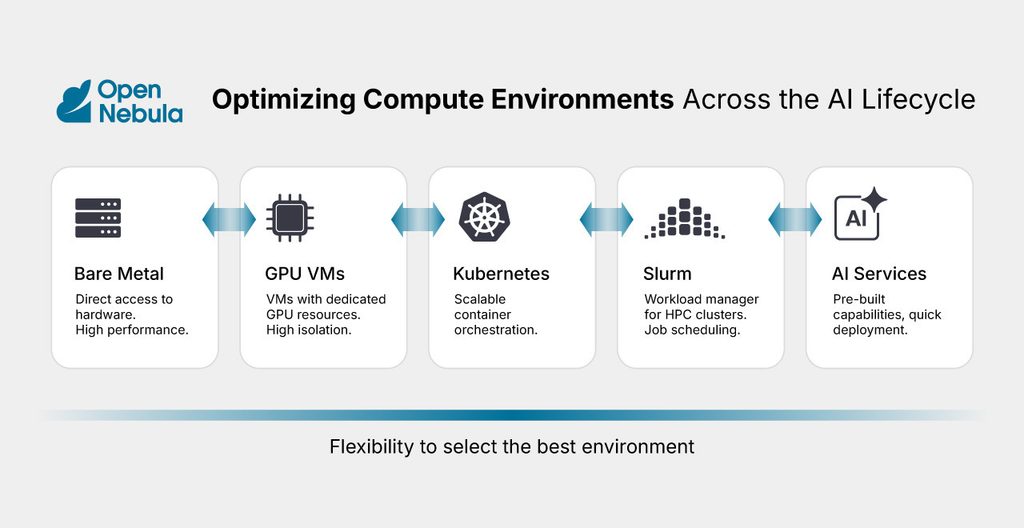
OpenNebula manages the underlying infrastructure allocation, tenant boundaries, networking, quotas and lifecycle. Kubernetes, Slurm, Run:ai and other workload schedulers can then operate within those boundaries. This infrastructure-first model is particularly relevant for NCPs. It allows a provider to offer different AI services while maintaining a common operational model and control plane underneath them.
It is also important for European sovereignty. OpenNebula is developed in Europe and fully open source. The control plane can remain under the operator’s control, without imposing a proprietary virtualization, Kubernetes or hardware stack. Operators retain freedom of choice across servers, accelerators, networking and storage.
This provides a practical foundation for the higher levels of technological and operational control that are becoming increasingly important in the context of CADA and European AI Gigafactory initiatives. Sovereignty does not mean that every component of an AI Factory must come from the same country or vendor. It means maintaining effective control of the infrastructure, data, operations and technology choices while avoiding unnecessary dependencies at critical layers of the stack.
NetApp: The Enterprise Data Platform for AI
If GPUs provide the computing capacity of an AI Factory, data is what keeps that capacity productive.
Training datasets, model weights, checkpoints, vector databases, application data and inference data have different access patterns, performance requirements and lifecycles. They also need to remain persistent as compute resources are provisioned, scaled, reassigned and eventually removed.
NetApp ONTAP provides an enterprise data foundation that can span these different environments. This is particularly valuable for enterprises and NCPs that already rely on NetApp for their virtualization and enterprise infrastructure. The same data platform can be extended into Kubernetes and AI rather than creating another isolated storage environment specifically for AI.
The value of the OpenNebula + NetApp combination, however, goes beyond attaching ONTAP storage to an OpenNebula cloud. Different parts of an AI Factory can use different integration paths according to their requirements.
OpenNebula + NetApp: Integrating Compute and AI Data
OpenNebula and NetApp address two closely related but different lifecycles.
- OpenNebula orchestrates the compute environment: physical servers, GPU VMs, Kubernetes clusters, Slurm environments, networking, accelerators and tenant boundaries.
- NetApp manages the persistent data environment: infrastructure storage, datasets, models, checkpoints and application data.
This separation means that an AI dataset can remain available while the compute environment consuming it changes. A Kubernetes cluster can be rebuilt, a GPU VM replaced, or a training workload moved to another pool of accelerators without making the lifecycle of the data dependent on that infrastructure.
GPU VMs and Infrastructure Storage
For virtualized infrastructure, OpenNebula provides native ONTAP integration. OpenNebula can orchestrate ONTAP volumes and LUNs, host mappings, iSCSI connectivity, multipath, snapshots, and cloning, including NetApp FlexClone. This provides an enterprise storage foundation for both conventional virtual machines and GPU-enabled VMs.
This integration is particularly relevant for organizations evolving existing enterprise infrastructure toward AI because it allows them to retain ONTAP while introducing a new cloud and virtualization control plane.
Kubernetes and Trident
Kubernetes requires a different integration model. With OpenNebula OneKS and NetApp Trident, each platform has a clear responsibility. OpenNebula provisions and manages the Kubernetes infrastructure, including compute, GPU and networking resources. Trident provides Kubernetes-native persistent storage from ONTAP directly to applications.
The persistent data therefore does not need to follow the lifecycle of the Kubernetes nodes or even the cluster itself. This is an important capability for AI applications, where datasets and model repositories often need to be shared by different applications and execution environments.
Shared AI Datasets, Models and Checkpoints
High-volume AI data should not necessarily travel through the same path used for VM system disks. The OpenNebula architecture allows the AI data path to be separated from the infrastructure storage path. GPU workloads can access shared data directly while OpenNebula controls the compute, network and tenant resources that are allowed to consume it.
This creates a model in which the same persistent datasets, checkpoints and model repositories can support workloads running in GPU VMs, Kubernetes or other execution environments. The compute environment can change while the data remains.
S3 and AI Data Pipelines
Object storage is increasingly relevant to AI pipelines for datasets, model artifacts and data exchange. S3 therefore represents another important integration area for OpenNebula and NetApp. It can complement block and file access and provide another mechanism for making persistent AI data available across different execution environments. This is one of the areas that can be incorporated into the joint OpenNebula + NetApp validation roadmap.
Data Protection and Resilience
AI infrastructure also changes the economics of data protection. GPU infrastructure can be reprovisioned. Training datasets, checkpoints and models may represent months of work and significant investment.
NetApp snapshots and replication capabilities can complement OpenNebula’s infrastructure lifecycle and recovery mechanisms, providing a foundation for protecting both infrastructure services and the data associated with AI workloads. The same architecture can also be extended toward multi-site AI environments, where infrastructure and data may need to be distributed or replicated across locations.
High-Performance AI Data Paths
At the highest end of AI infrastructure, keeping expensive GPUs continuously supplied with data becomes a key design consideration. The separation between infrastructure storage and the AI data path creates a foundation for exploring technologies such as NFS over RDMA and NVIDIA GPUDirect Storage.
In this model, OpenNebula can orchestrate the GPU and high-performance network resources assigned to the workload, while NetApp provides the persistent data platform and NVIDIA provides the accelerated infrastructure and data path. These are areas for joint technical validation and innovation, rather than capabilities that should be assumed to be validated today.
One Data Platform Across the AI Lifecycle
The result is more useful than a single storage connector. An AI workload has a data lifecycle:
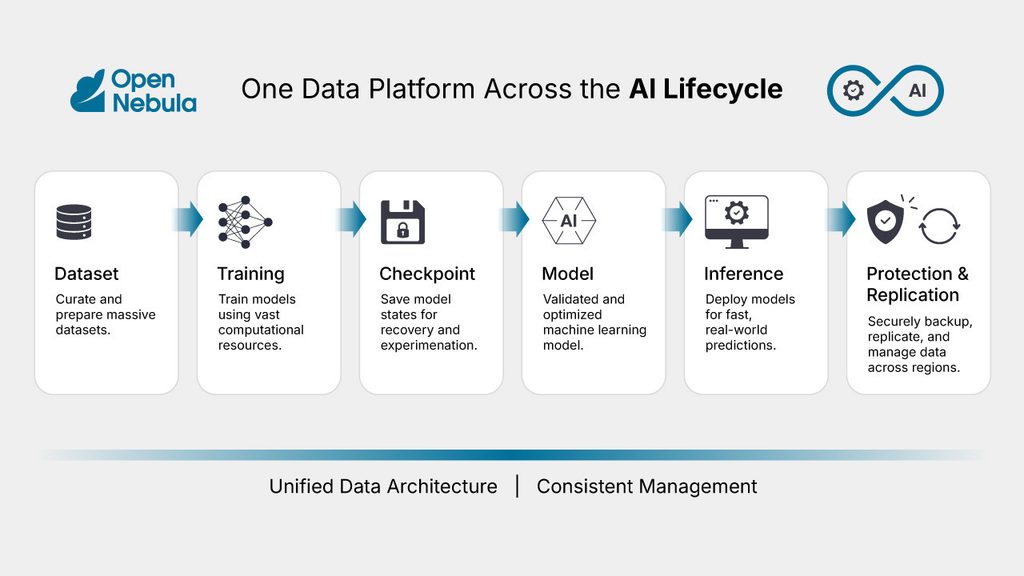
At different stages, the compute environment may change.
OpenNebula provides the infrastructure orchestration layer that allows those different compute environments to coexist. NetApp provides the persistent data foundation that allows data to survive and be reused across them.
| AI Factory Service | OpenNebula Role | NetApp Role |
| GPU VMs | GPU VM lifecycle and isolation | ONTAP block/file storage |
| Kubernetes / OneKS | Cluster, GPU and network lifecycle | Trident CSI + ONTAP |
| Training / Slurm | Compute infrastructure orchestration | Shared datasets and checkpoints |
| AI inference | GPU and service infrastructure | Models and inference data |
| AI data repositories | Access infrastructure and tenant boundaries | Persistent file/object data |
| Data protection / DR | Infrastructure recovery orchestration | Snapshots and replication |
| High-performance AI I/O | GPU and network orchestration | Advanced data paths subject to joint validation |
The important point is that OpenNebula does not try to replace the enterprise data platform, and NetApp does not need to become the AI infrastructure control plane. Each platform remains focused on the layer where it provides the most value.
From Enterprise Cloud to Sovereign AI Factory
This architecture is also relevant because many European organizations are facing two infrastructure transformations at the same time. They are looking for alternatives to VMware while simultaneously investing in new AI capacity.
Those projects do not necessarily require two separate infrastructure strategies. For organizations already using NetApp, there is a natural evolution:
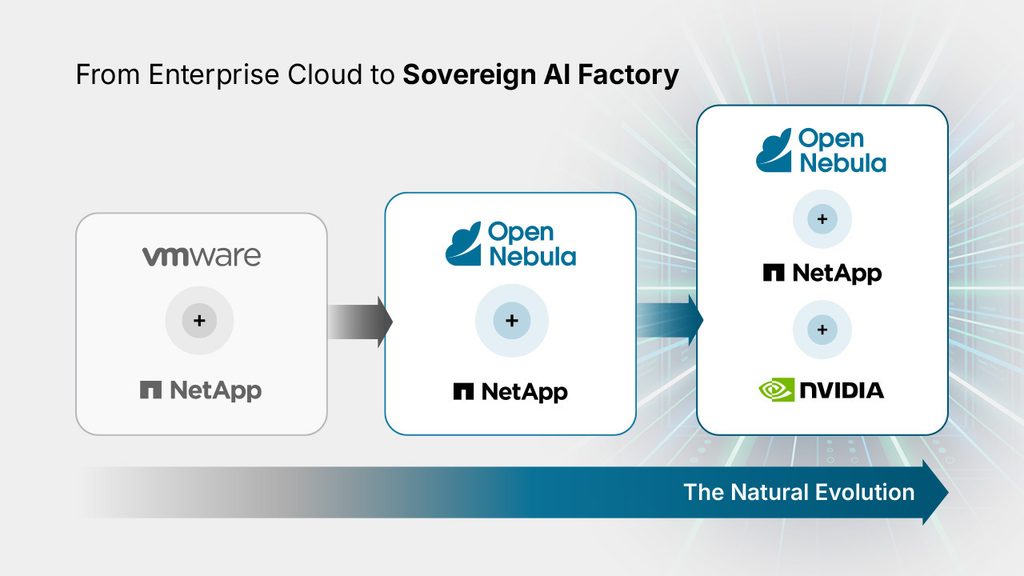
NetApp remains the strategic data platform. OpenNebula provides the open cloud and AI infrastructure control plane. NVIDIA accelerated infrastructure can then be incorporated as organizations expand from enterprise virtualization into GPU VMs, Kubernetes, Slurm and AI services.
For NCPs, the same architecture makes it possible to deliver traditional enterprise cloud services alongside new GPU and AI services using a common infrastructure foundation.
Building a European Sovereign AI Infrastructure
Europe’s AI ambitions require significant new infrastructure, but capacity alone will not deliver sovereignty. The emerging direction around CADA and European AI Gigafactories increases the importance of control over critical infrastructure and software, interoperability, openness, data governance, and the ability to incorporate European technologies without becoming dependent on a vertically integrated proprietary stack.
A modular architecture provides another path.
NVIDIA provides the accelerated infrastructure.
NetApp provides the enterprise AI data platform.
OpenNebula provides the European, open source sovereign cloud and AI infrastructure control plane.
Together, they provide a foundation on which enterprises and NCPs can build AI Factories that combine world-class accelerated computing and enterprise data management with openness, infrastructure independence, and sovereign operational control.
And, importantly, the architecture can evolve. New accelerators, storage technologies, workload platforms and European technologies can be incorporated without having to replace the control plane or redesign the entire AI Factory.
That combination of performance, enterprise data management, openness and control is what can make the next generation of European Sovereign AI Factories possible.
Discover how OpenNebula enables sovereign AI Factories with open source cloud management for accelerated infrastructure.

0 Comments