
NVIDIA Run:ai, an AI workload and GPU orchestration platform within NVIDIA DSX OS, the open, modular software portfolio of the NVIDIA DSX AI Factory Platform, is now fully open source. NVIDIA Run:ai helps organizations maximize GPU utilization and AI workloads through policy-driven scheduling and GPU allocation across teams and projects on shared AI infrastructure. The open source release makes it easier for NVIDIA DSX ecosystem partners to integrate these capabilities into their own platforms and services.
OpenNebula has integrated open source NVIDIA Run:ai into the OpenNebula AI Cloud Platform, with automated deployment and operation through OneKS, its Kubernetes service. NVIDIA Run:ai orchestrates AI workloads and shared GPU capacity, while OpenNebula provides a single control plane for secure multi-tenancy, identity, infrastructure provisioning, networking, storage, observability and lifecycle management.
Together, OpenNebula and NVIDIA Run:ai give AI cloud and AI factory operators a consistent operational model from cloud infrastructure and Kubernetes provisioning to AI workload scheduling and GPU allocation. Customers can deploy and operate NVIDIA Run:ai as part of a complete AI infrastructure platform rather than managing it as an isolated component.
OpenNebula is already validated by NVIDIA across key layers of the AI Cloud stack, including NVIDIA AI CloudReady, NVIDIA GPU virtualization, and NVIDIA Spectrum-X networking. The NVIDIA Run:ai integration extends this validated stack into AI workload and GPU orchestration.
OpenNebula has completed NVIDIA Run:ai compatibility certification and is now included among the partner-compatible Kubernetes distributions supported for self-hosted NVIDIA Run:ai deployments.
The integration also reflects a shared commitment to open source architecture. OpenNebula is a fully open source platform, and the open source release of NVIDIA Run:ai enables OpenNebula to integrate its GPU orchestration capabilities more deeply into the OpenNebula AI Cloud Platform.
From GPU Infrastructure to AI Services
GPU infrastructure is expensive, and making it available is only part of the challenge. Operators also need to decide how that capacity is shared, who gets access to it, how workloads are prioritized, and how to keep GPUs productive across different teams and projects.
NVIDIA Run:ai addresses this at the workload level. It orchestrates AI workloads and GPU resources within Kubernetes, dynamically allocating capacity to help improve GPU utilization and AI workload throughput across shared infrastructure.
OpenNebula works at the layer underneath, managing the Kubernetes environments and the cloud infrastructure that provides that GPU capacity. This creates a common operational environment across:
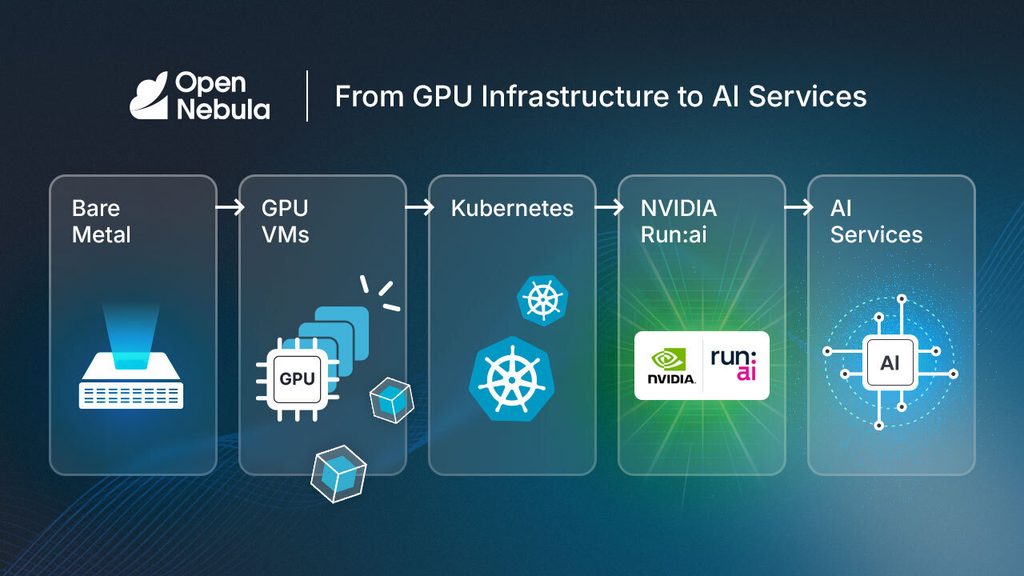
Within this architecture, OneKS delivers Kubernetes clusters as managed OpenNebula resources, taking care of their infrastructure provisioning and lifecycle. Run:ai then provides the GPU workload orchestration layer for AI-oriented OneKS environments.
The roles are complementary: Run:ai manages how AI workloads consume GPUs inside Kubernetes, while OpenNebula, through OneKS, manages the Kubernetes environment and the GPU infrastructure underneath it.
Run:ai Delivered through OneKS
Open sourcing Run:ai makes it possible for partners to go well beyond basic interoperability. Our goal is to make deploying Run:ai in an OpenNebula AI Cloud a normal platform operation. OneKS turns Kubernetes clusters into OpenNebula-managed cloud resources. It automates their infrastructure provisioning and lifecycle while allowing operators to create different worker configurations, including GPU-enabled nodes running on OpenNebula-managed infrastructure.
We have extended this experience with the new Helm Chart Catalog for OneKS. The catalog allows predefined applications and platform components to be deployed on OneKS clusters using validated Helm configurations. NVIDIA Run:ai is one of the configurations we are integrating into this model.
For an AI Cloud operator, the experience is intended to be straightforward:
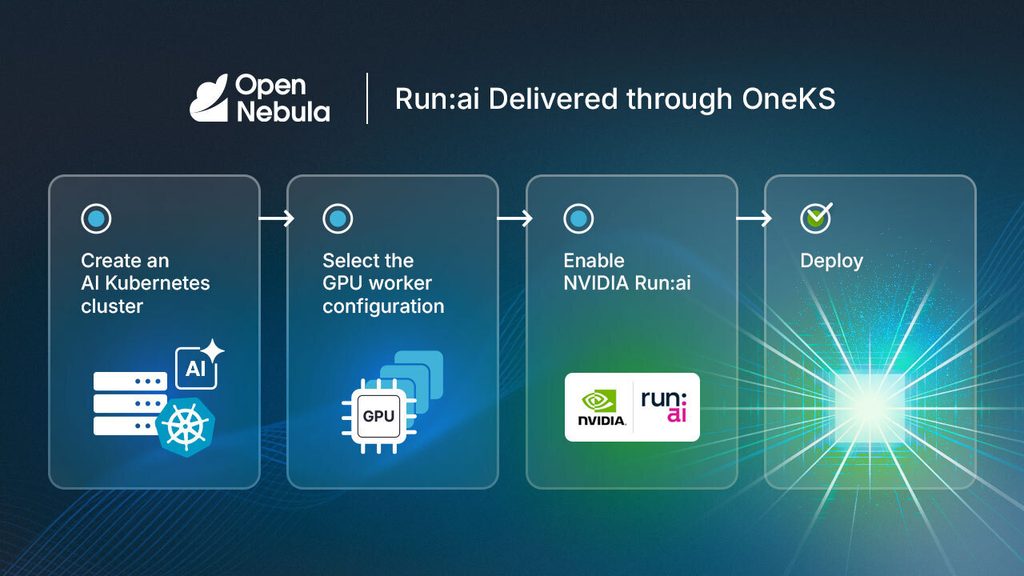
OpenNebula takes care of provisioning the RKE2 Kubernetes cluster and its GPU worker nodes, while OneKS automates deployment of the required Run:ai configuration and associated components. NVIDIA Run:ai therefore becomes part of the configuration of an OpenNebula-managed AI environment, rather than an unrelated application that customers need to install and operate separately.
NVIDIA Run:ai open source software will be delivered as an integrated capability of the OpenNebula AI Cloud Platform. Customers using this offering do not require a commercial NVIDIA Run:ai software license. Support for NVIDIA Run:ai is included as part of the OpenNebula AI Cloud Subscription, alongside other integrated NVIDIA DSX OS™ components. OpenNebula provides the integration, automation, lifecycle management, interoperability, and operational support needed to run these components as part of a complete AI Cloud environment.
For NVIDIA Cloud Partners and Neoclouds, the same platform can also provide the foundation for their own managed AI Cloud services, allowing them to offer Run:ai-enabled Kubernetes environments to their customers while retaining control over the underlying GPU infrastructure and cloud platform.
From Workload Orchestration to Elastic GPU Capacity
The integration also creates opportunities beyond the deployment and operation of NVIDIA Run:ai itself. Run:ai has detailed visibility into AI workload demand inside Kubernetes, including GPU requirements, priorities, and quotas. OpenNebula, through OneKS, manages the Kubernetes environment and the GPU infrastructure underneath it, including the worker capacity available to each cluster.
Connecting these two layers opens the door to elastic GPU capacity. We are developing an Elastic Capacity Manager that can turn workload demand and service policies into infrastructure actions.
This will allow NVIDIA Cloud Partners and Neoclouds to move beyond fixed GPU clusters and offer more flexible capacity products combining guaranteed GPU capacity, on-demand burst, and preemptible capacity. The business opportunity is straightforward: providers can charge for guaranteed access and burst capacity while also monetizing otherwise idle GPUs through lower-priority workloads. When premium demand increases, that capacity can be reclaimed automatically to meet the contracted service level.
The distinction is important: this is not just Kubernetes autoscaling. The goal is not only to improve GPU utilization, but to increase revenue per installed GPU, improve the economics of reserved capacity, and give providers more differentiated service models without compromising enterprise-grade capacity guarantees. NVIDIA Run:ai optimizes AI workloads inside Kubernetes, while OpenNebula makes the GPU infrastructure underneath those environments elastic. Together, they create the foundation for a more flexible and commercially efficient AI Cloud model.
This is one of the new capabilities we will showcase at GTC Berlin 2026. Our NVIDIA Run:ai + OpenNebula Elastic GPU Capacity demonstration will show how Run:ai workload orchestration and OpenNebula infrastructure orchestration can work together to move from fixed Kubernetes GPU clusters toward elastic GPU capacity services.
Building an Open and Sovereign AI Cloud
NVIDIA’s decision to open source the full Run:ai platform is particularly significant for organizations that see AI infrastructure as a strategic, long-term capability. OpenNebula defines sovereignty as not only about where GPUs, data, or workloads are located, but also about maintaining control over the software stack used to operate that infrastructure, avoiding unnecessary dependencies, and retaining the freedom to integrate and evolve technologies over time.
That is precisely the direction we are taking with the OpenNebula AI Cloud Platform. As a fully open source cloud platform, OpenNebula provides a common control plane for accelerated infrastructure while allowing organizations to retain control over how their AI Cloud is deployed and operated. NVIDIA Run:ai becoming open source fits naturally into this model, bringing GPU workload orchestration into an architecture that can utilize NVIDIA infrastructure through different consumption models, from bare metal and GPU virtual machines to Kubernetes, Slurm, and higher-level AI services.
For NVIDIA Cloud Partners and Neoclouds, this provides a foundation for building differentiated AI Cloud services without giving up control of the underlying cloud platform. For enterprises and AI Factory operators, it provides an integrated way to operate shared GPU infrastructure while retaining control over infrastructure, data, operational policies, and technology choices. And for sovereign AI initiatives, it shows that taking advantage of NVIDIA accelerated computing ecosystem does not require giving up control of the cloud management layer. Organizations can combine NVIDIA technologies with a fully open source platform and build an architecture that remains open, interoperable, and under their control.
For OpenNebula, this is another step toward what we have been building for some time: an open and sovereign AI Cloud Platform that gives organizations control over the complete path from physical GPU infrastructure to production AI services.

0 Comments